
Marine and high-impact isolation
Special Vibration Isolators
This family covers HGGS stainless steel wire rope isolators and HGGN compound anti-impact isolators for demanding equipment installations.
Request a quote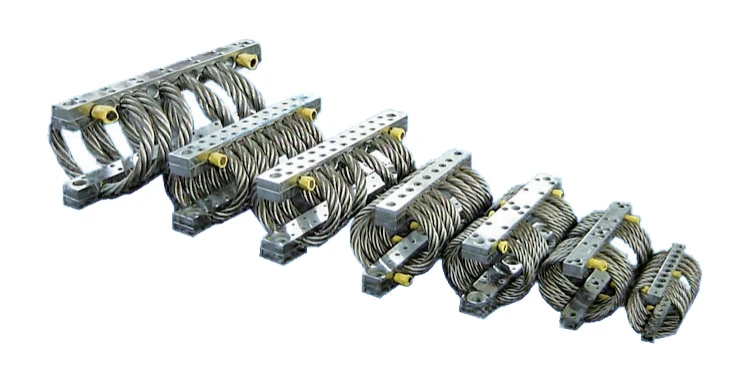
Working principle
HGGS relies on all-metal wire rope deformation. HGGN combines helical wire rope with elastomer to increase damping, stiffness and energy absorption.
Construction
Stainless steel cable, stainless structures and compound elastomer-encased wire rope constructions.
Applications
Marine power equipment, shipboard systems, low natural frequency soft-deck applications and critical equipment isolation.
Series in this family

HGGS Stainless-Steel Isolators
HGGSA stainless-steel isolation range combining nonlinear stiffness with multiple mounting orientations.
Catalog / inquiry product

HGGN Composite Shock Isolators
HGGNA composite construction combines wire-rope isolation with an elastomer to increase support stiffness and damping.
Catalog / inquiry product

OVTS Special Wire-Rope Isolators
OVTSSpecial wire-rope isolation configurations for equipment protection, with model-specific loading and installation requirements.
Catalog / inquiry product

OVTN Rubber-Coated Composite Isolators
OVTNRubber and wire-rope elements are combined in T, Z and X configurations for enhanced damping and shock control.
Catalog / inquiry product

OVTD Multi-Degree-of-Freedom Hangers
OVTDIsolation hangers with catalogue-defined support and installation geometry.
Catalog / inquiry product

OVTG All-Metal Isolation Pipe Clamps
OVTGAn all-metal clamp and elastic liner support pipework while providing vibration isolation.
Catalog / inquiry product

OVTX All-Metal Isolators
OVTXAn all-metal elastic support for isolation duties where elastomer exposure or ageing is a concern.
Catalog / inquiry product
Continuous vibration or transport shock?
Use a vibration-isolation review for pumps, cabinets and transported equipment. The motion-sizing calculator covers supported end-stop shock absorber cases; it does not calculate isolation performance.
I only know the equipment weight. Can I start?
Yes. Send the weight, support layout, equipment type and any photos or test report. Mark frequency or shock data as unknown; engineering review must establish them before a performance claim can be made.
Can I divide the total weight by four mounts?
Only a symmetric layout with a centered center of gravity and the corresponding static assumptions supports equal sharing. An offset center of gravity, torque or transport acceleration can produce unequal loads. Supply support positions and the center of gravity, or mark it unknown.
Rubber or wire rope isolators?
Compare the required frequency range, load direction, allowable displacement, damping and environment. Neither material is universally better. Directional load and stiffness data, shock conditions and durability requirements determine the candidate.
Unknown data is welcome: say what is measured, estimated or not yet known. Photos, drawings and existing test records help define the next checks.
Send an isolation brief